
From SEO to AEO: Optimising for AI-led Search
Next session: 05 NOV, 2026
£499per personex VAT
5(4)

Confused by the latest buzzwords and acronyms in search marketing? Jellyfish Training Director, Chris Hutty, explores AEO and GEO, and how AI is transforming the way brands appear in search.
SEO has never stood still, but the pace of change in the past 2 years has been dizzying. With the rise of AI-powered tools like Google’s AI Overviews, Gemini, Claude, and the conversational shift introduced through Google’s AI Mode, brands are being forced to rethink what visibility looks like, and how to earn it.
This is where Answer Engine Optimisation (AEO) and Generative Engine Optimisation (GEO) come into focus. These strategies revolve around developing content that increases your visibility in AI-generated responses, whether that’s within traditional search engines like Google and Bing or through standalone generative platforms like ChatGPT, Claude, and Perplexity.
Some try to draw lines between the two, suggesting AEO is tied more closely to embedded AI within search engines, while GEO covers search in Generative AI tools such as ChatGPT. But in reality, the distinctions are increasingly blurred. Google’s AI Mode, for example, is both a search engine and a generative engine. At Jellyfish, we commonly use GEO as a broader framework. It focuses not only on appearing in results, but on shaping how Large Language Models perceive and describe your brand across all formats.
As an example, think of a premium brand like Louis Vuitton. Their presence in generative environments isn’t just about showing up in search. It’s about reinforcing the concept of luxury across every asset: copy, visual creative, even the tone of voice in video. In this AI-first era, the platforms and interfaces may be new, but the fundamentals of marketing (relevance, consistency, and authority) remain the same.
AI-driven experiences like Google AI Mode, ChatGPT, Claude, and Perplexity haven’t reinvented the rules of search. What they’ve done is bring longstanding search principles into sharper focus. We’re not throwing away the SEO playbook, we’re reapplying it through a more intelligent and conversational lens.
In reality, many of the factors now influencing visibility in answer engines have been part of Google’s ranking systems for years. The AI-first shift has simply made those expectations more explicit and harder to ignore. Structured content, topical depth, and clearly defined expertise have been prerequisites for much of the last decade, we’re now just doubling down on these for LLMs.
That’s why our approach at Jellyfish hasn’t been one of reinvention, but refinement. We’ve doubled down on core content strategies that continue to work:
If your content doesn’t help a user quickly, or provide a clear, stand-alone answer - it’s unlikely to gain traction in generative environments.
So what should brands be doing right now?
Build topical relevance: Focus on building content around the customer journey, addressing pain points, challenges, and triggers that lead them to your solutions. This approach, rather than just identifying search opportunities, helps create entity-rich content that demonstrates expertise and topical depth.
Prioritise clarity and structure: Short, specific paragraphs that answer real user questions are more likely to be extracted. Individual sentences or phrases need to be capable of standing alone to directly address a query. Content should be designed to be scrape-friendly, with ideas broken into bite-sized, structured formats that AI systems can easily parse and cite.
Keep content fresh: We’re seeing signs that AI engines value updated, relevant information even more than traditional search did. Content that reflects the latest thinking, uses up-to-date examples, and aligns with current discourse is more likely to be selected in generative responses. Brands should view content updates not as optional, but as essential.
Go multimodal: If your brand doesn’t have a video or image-led content strategy, you’re already behind. AI tools are increasingly interpreting content across multiple formats to build a richer understanding of your brand. Think in terms of how your image, audio, video and text based content collectively signal expertise, identity, and intent to an LLM.
Think beyond your website: Your site is only one of many digital touchpoints influencing AI perception. Your presence on social platforms, forums like Reddit or Quora, trusted review sites, and content hubs is just as critical. Ask yourself: where does your audience go to talk about you, and are you shaping that conversation?
Google’s introduction of AI mode may be recent but its forerunner - AI Overviews - have been shaking up the search landscape for a while now.
While data from Google is limited, independent research and early analytics point to a familiar trend: users are searching more, but clicking less. According to Pew Research, users are significantly less likely to click when AI overviews are present: just 8% compared to 15% in traditional listings. We can assume a similar pattern of behavior within AI Mode, where clickable links are less prevalent.
Google, for its part, has stated that overall click volume remains stable and that the quality of those clicks has actually improved (Google Blog). This narrative has been challenged, particularly by publishers. For example, data from Digital Content Next, reports referral traffic drops of 1% to 25% , and a Guardian report citing up to 79% traffic losses for some top-ranking articles.
The conversational tone of AI mode and other AI led platforms is also leading a shift towards more granular and natural language queries. This change in behavior, combined with the lack of data from these platforms, makes traditional keyword research less useful. Instead, we’re being forced to think more like strategists, anticipating user needs and designing content ecosystems that cater to real conversations, not just search terms.
We’re seeing what’s been dubbed the great decoupling: impressions are rising, but clicks are flattening or even dropping, especially for editorial content.
A drop in referral traffic from search means measuring visibility in Answer Engines becomes as important as measuring traffic. At Jellyfish, we do this using our proprietary Share of Model platform. As well as measuring brand visibility and sentiment, the ‘Share of Search’ module allows us to track when and where we appear across Google AI overviews, ChatGPT, and perplexity for individual search queries, alongside our traditional SERP rankings.
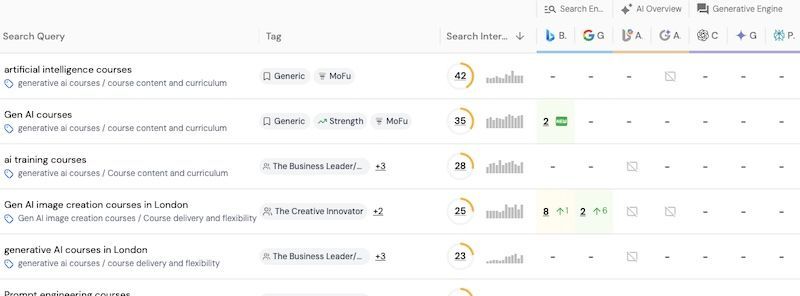
Clicks still matter. But in a world where zero-click searches are the norm, visibility without traffic still carries value. Branded search volume, for example, becomes a proxy for wider brand recognition. If AI mentions your brand, users may search for it directly later.
SEO best practice hasn’t disappeared. It’s just evolved. Authority still comes from the usual E-E-A-T suspects: expert-led content, topical depth, internal linking, and trusted citations (amongst others). But in the context of AEO and GEO, that authority must extend beyond your domain.
You need:
Structurally, we’re still in early days. Semantic html, relevant schema and content delivered server side, rather than via client side JS are all established SEO tactics that should improve your chances of attaining visibility in AI led search.
The next 12 to 18 months are likely to bring maturity rather than disruption, as the major platforms refine their AI offerings and look for ways to monetize them. With more data and time for testing, we’ll start to separate hype from reality - gaining clearer insights into how LLMs actually work and how behaviors differ across platforms.
At the same time, user behavior is still evolving. We’re on the cusp of a shift from answer engines to action engines. AI agents won’t just help users gather information, they’ll make decisions, take actions, and shape outcomes. Whether it’s booking a holiday or selecting a supplier, AI will become the gatekeeper to conversion. Brands that aren’t visible in those critical moments won’t just miss the conversation. They’ll miss the action!
If there’s one thing we can be sure of, it’s that the future isn’t coming. It’s already here.
This article was updated in May 2026
If you’re looking to get hands-on with the tools, techniques, and strategies that drive visibility in AI-led search, check out our course: From SEO to AEO: Optimising for AI-led Search.
Whether you're in search, content, or digital strategy, this training will help you understand how large language models interpret brand content and what it takes to influence the new generation of search experiences.
Take the next step in your digital learning journey with these featured courses.
Share article

Director, Training

Access the latest digital marketing insights, valuable tips and relevant advice from our experts.
Curious about Google's ad ranking process? Explore our guide to understand the ad rank formula, factors influencing it, and learn how to enhance your ad rank for better search results.
Explore how marketers can bridge the gap between ad reach and audience attention with DV360 Custom Bidding.
Struggling with limited conversion data in Google Ads? Discover 8 actionable tactics to boost performance for businesses with lower conversions.
Get some great tips for cool things you can do using window functions in BigQuery.
Learn how to customise scorecard metric names within Google Looker studio with our easy to follow, illustrated guide
Google has now made tracking conversion rates easier for marketers. Learn about the recent introduction of ‘key event rate’ directly into GA4 reports, making it simpler to measure campaign success.
We spoke with our experts across the global SEO team at Jellyfish, who revealed their journeys into the industry and top tips on kick-starting a career in SEO
Boost your SEO with Topic & Entity optimization. Learn how this dynamic duo improves search rankings and drives organic traffic
In today's digital world, platforms such as Facebook, Instagram, and TikTok are essential spaces for connecting with your customers. Social media isn't just a "nice to have" it's a must-have
Introduction to Traffic Dimensions in GA4: Source, Medium, Campaign and Beyond
Training Director, Chris Hutty shares how semantic HTML and accessibility best practices are baked into the redesign of Jellyfish Training pages, using AI as a sounding board.
Supercharge your GA4 reporting by tailoring it to your team’s needs! Analytics Training Director Chanté Matthews-Mohammed reveals her top customisation tips to help you deliver sharper insights and drive smarter, faster decisions with ease.
For further information or any questions you may have, our team is here to help.