2026-07-28
Can Creativity Win Minds and Models?

Marketing science has given us a lot to agree on over the last century: marketing communication is about building memories and associations in the human mind that can be triggered at key moments in the decision-making and buying journey.
But a profound shift is underway. Artificial Intelligence provides more than a new toolkit to create brand content with; it is building a completely new audience to create content for. Marketers increasingly have two audiences - the human buyers they have always served, and now the algorithms, agents, and Large Language Models (LLMs) that sit directly in the path of consumer discovery.
Every era has its ‘Share of…’
Winning in the GenAI era requires a new marketing metric: Share of Model™. This is the latest in the canon of marketing’s ‘share ofs’, following Share of Market, Share of Voice, and Share of Search. Today brands must track their Share of Model™ to measure and optimize their visibility, accuracy, and perception within the LLMs driving discovery. With platforms like Google’s Gemini serving recommendations to over 2 billion people weekly, the brands these models discover and recommend will grow fastest.
In a new research project with INSEAD’s David Dubois, Tom Roach, VP Brand Strategy and Natasha Wallace, CSO, Strategy, AI & Planning at Jellyfish used Share of Model™ to explore whether and how AI and humans respond to creativity differently, uncovering what brands need to create for a world of dual audiences and AI-mediated consumer journeys.
Key Discovery: We have a ‘two audience’ problem
We analyzed over 480 Cannes Lions-entered ads to see how both humans and AI models ranked their effectiveness. The study found there is zero correlation between how humans and AI models rank the impact of creative work. The top 10 ads preferred by AI and the top 10 preferred by humans were almost completely different.
Specific structural ad features explained AI ratings three times better than they explained human ratings. This human-AI gap exposes a fundamental difference in how these two audiences process information:
- Humans favor the gestalt (the whole story): Wired for nuance, emotional payoffs, and creative disruption.
- AI favors the explicit: Models do not get bored, nor do they "feel" a narrative arc. They scan content systematically, prioritizing clear hierarchical signals, product-centric descriptions, and structural relevance.
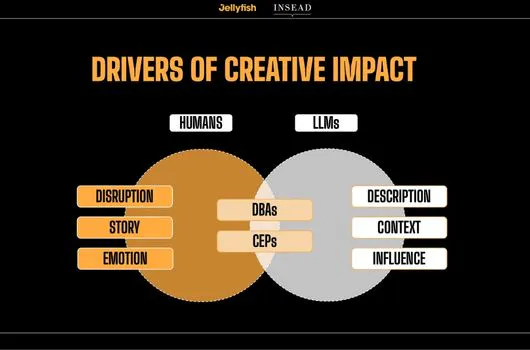
Emotion vs Clarity: Creative Divide
This gap revealed itself in surprising ways across media:
- The Wine Ad Anomaly: Humans find slow-motion footage dreamy and desirable. AI penalizes it, inferring through frame-by-frame analysis that slow motion yields less "relevant information" per second.
- The Contextual Jeweler: A luxury brand ranked exceptionally high with AI by framing its offerings around context and reasons to buy (weddings, gifts, engagement), rather than heavily product focused. AI rewarded this explicit structure.
- The Semantic Ski Trap: A premium ski brand highlighted its skis' "rigidity" a top feature for experts. AI interpreted "rigidity" as a negative, likely pulling from novice forum posts associating the word with difficulty.
“Humans interpret the whole thing when they see an ad, meaning they read the story. Models do things differently. Despite almost no overlap in what AI and humans favor, the answer isn’t two strategies - it’s stronger brand systems."
Tom Roach, VP Brand Strategy, Jellyfish
Avoid "Creative Flattening"
If marketers believe they need to pack ads with dense, descriptive data to put what the LLMs favor before what human audiences favor, we could risk triggering bigger problems in creative effectiveness: Creative Flattening.
Over-Optimizing for machines create a chain reaction: Dense, Data-Packed Ads ➔ Loss of Human Emotional Resonance = Creative Flattening
Pleasing the algorithm with information-dense checklists fails the human viewer. The core creative challenge now facing marketers is clear: How do we improve model receptivity without damaging creativity?
Build Integrated Brand Systems
Despite these differences, the answer isn’t two distinct approaches. The opportunity lies in building integrated brand systems, with consistent messaging and assets that work across both human and machine interpretation.
AI doesn’t just learn from advertising. It learns from everything people say about your brand. Influencer and social content currently appear in roughly 60% of AI recommendations, with YouTube serving as a source for 1 in 4. Building brands today is less about one-off creative fireworks and more about a balance of storytelling and systems thinking.
At Jellyfish, we help brands navigate their Gen AI transformation and stay one step ahead through AI-driven creative services, structural audits, and specialized Share of Model™ insights.