2025-12-18
UX + CRO: The collaborative engine driving digital success

In the fierce competition of today’s digital world, brands must deliver experiences that are both a joy to use and highly effective at achieving business goals. Too often, User Experience (UX) and Conversion Rate Optimization (CRO) are treated as separate disciplines, leading to fragmented efforts. The truth is, these are two sides of the same coin, and a truly successful digital presence requires their close, continuous collaboration.
This unified approach doesn't just deliver better outcomes; it creates a powerful, self-improving mechanism that addresses client challenges more holistically.
Shared foundations, enhanced application
At their core, UX and CRO are intensely research-driven. They both rely on a blend of qualitative and quantitative data to understand user behavior, but they apply that understanding differently:
- UX takes the broad view, exploring user motivations, pain points, and the overall journey through methods like usability testing, interviews, and detailed journey mapping. Its goal is to design an experience that is intuitive, engaging, and cohesive.
- CRO zooms in on performance, using analytics and A/B testing to pinpoint friction and optimize specific elements for measurable results. Its focus is on how to make a touchpoint perform better and achieve a measurable outcome.
When united, UX designs the experience based on user needs, and CRO refines it based on measured results. This combined, data-led approach eliminates guesswork, mitigating the risk of expensive changes by backing every decision with both qualitative insight into what users want and quantitative metrics on what drives conversions.
The power of mutual learning
The most transformative aspect of this collaboration is the mutual evolution it fosters within both teams. Instead of operating in isolation, they become mutually shaping disciplines:
- UX designs for testability: UX designers begin to anticipate optimization opportunities, designing initial wireframes and flows with clear, testable hypotheses in mind. They factor in usability, hierarchy, and emotional impact as key performance indicators.
- CRO broadens its scope: CRO specialists start to factor in deeper usability and emotional impact, grounding their experiments in richer user insights rather than purely technical A/B tests.
- Data-informed creativity: This partnership also acts as a vital check for creative and visual designers, ensuring that instinct is always grounded in research. Every design choice supports both superior usability and measurable performance.
This mutual learning also empowers the individual practitioner. It encourages both UX designers and CRO specialists to naturally expand their expertise beyond their typical scope, focusing on delivering solutions that are not just visually appealing, but are proven to create measurable value for both the user and the client's business. By merging empathy with evidence, the teams collectively grow into a smarter, high-performing unit.
Enhanced Customer Experience (Maximized ROI, Smarter Teams)
UX informs CRO: Understanding why users behave
Example Influence: Usability test findings identify pain points that become CRO test hypotheses (e.g., "Users are confused by this button," leading to A/B tests on button copy/placement).
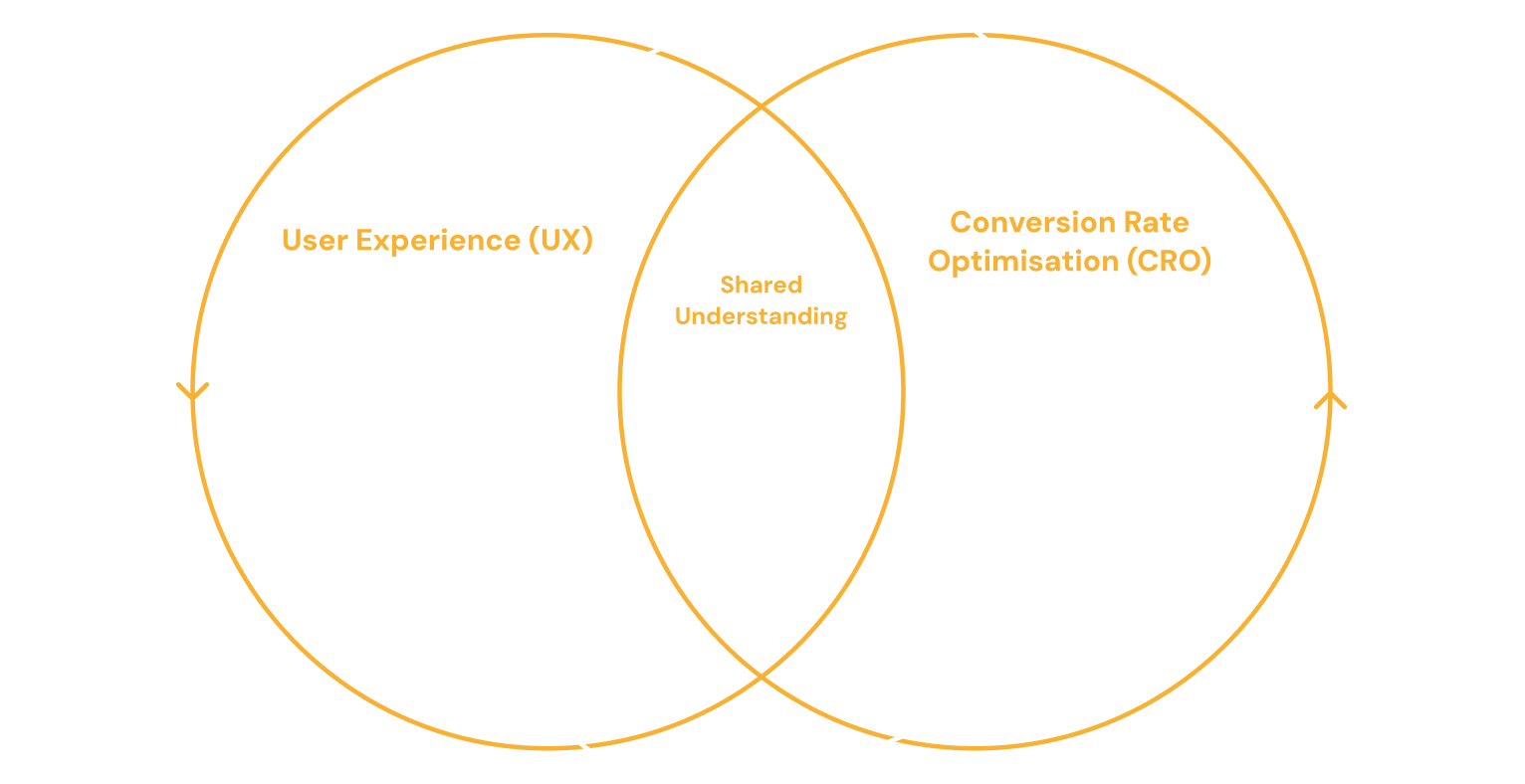
CRO informs UX: Quantifying what works best
Example Influence: A/B test results reveal a specific layout performs better, influencing future UX design patterns for a site rebuild. Analytics data highlights drop-off points, prompting deeper UX research.
Real-world impact: Collaborative success stories
Breaking down silos leads directly to measurable improvements. At Jellyfish, we've seen firsthand how collaborative efforts solve complex client challenges and drive superior results:
- Optimizing mobile rail ticket purchases: We boosted rail ticket conversions by replacing bulky journey summaries with smart, collapsible accordions. By clearing the "first fold" to prioritize key journey options for mobile users, we drove a 5.65% increase in selection taps and a 3.13% uplift in purchase handoffs.
- Streamlining the home warranty funnel: By simplifying a complex "quote and buy" process, our UX and CRO teams transformed the customer experience. Focusing on intuitive form design and a more refined flow removed friction for users, resulting in a 20.99% increase in visit to purchase rates.
These outcomes prove that when UX and CRO professionals collaborate, they create experiences that are both user-centric and conversion-optimized, leading to far better client results than either team could achieve alone.
“UX and CRO don’t just optimize products, they optimize each other’s practice, creating smarter teams and better, more profitable customer experiences.”
Mark Clayton, Senior Designer, UX, Jellyfish
From Collaboration to Continuous Advantage
UX and CRO collaboration should not be optional, it is a cornerstone of modern Customer Experience (CX). Maximum digital impact is achieved when all disciplines (Analytics, Content, SEO, UX, CRO, and Development) are aligned, but the continuous feedback loop between UX and CRO is the engine that drives perpetual improvement.
When these two disciplines are united, design becomes more evidence-led, optimization becomes more empathetic, and the resulting customer experience is continuously refined, cohesive, and high-performing.