2026-04-02
You need to plan around Context Entry Points

Chances are you know about Category Entry Points (CEPs).
These are the needs, occasions, or situations that lead a consumer to think about a product or brand. By working on these moments, marketers seek to increase the associations that the brand has in a must win occasion. Through advertising, marketers build cues and position their solution around needs that trigger specific brand recall.
Marketers use Category Entry Points to understand how their brand comes to mind when people enter an occasion. But with the growth of AI models, we must update that thinking to encompass a new player, introducing Context Entry Points.
Building for when a brands come to mind
Even in a single category, different brands may come to mind at different Category Entry Points. Let's take an example. When thinking about what alcohol to buy, different brands will come to mind depending on the situation. What brand do you think about for a dinner party versus a pool party? What brands do you consider for a father-in-law's birthday versus celebrating Valentine's Day? Even without data, you will instinctively frame different brands around these different situations.
This is why Category Entry Points are valuable, they not only frame presence, but also link to consumer marketing opportunities.
The ambition for Category Entry Points is to increase the chance that your brand comes to mind in the places and spaces surrounding buying occasions. But it’s no longer just people who are thinking about purchase. Over 900 million people use ChatGPT every week. Over 750 million use Gemini every month. These AI models are rapidly surfacing, recommending and even purchasing products and services on behalf of people.
Advertising has been a business focused on people’s thoughts and actions. That’s changed. As people seek advice from and even fully delegate decisions to AI models, marketers need to expand their thinking for models that influence and agents that purchase.
A new entry point for AI
An article in Harvard Business Review last year used Share of Model™ insights to show the differences in how LLMs and people think about brands in a range of categories. Since then, further analysis and practical experience has demonstrated that these models are highly sensitive to context.
A sensitivity that in some ways reflects the manner in which people are affected too.
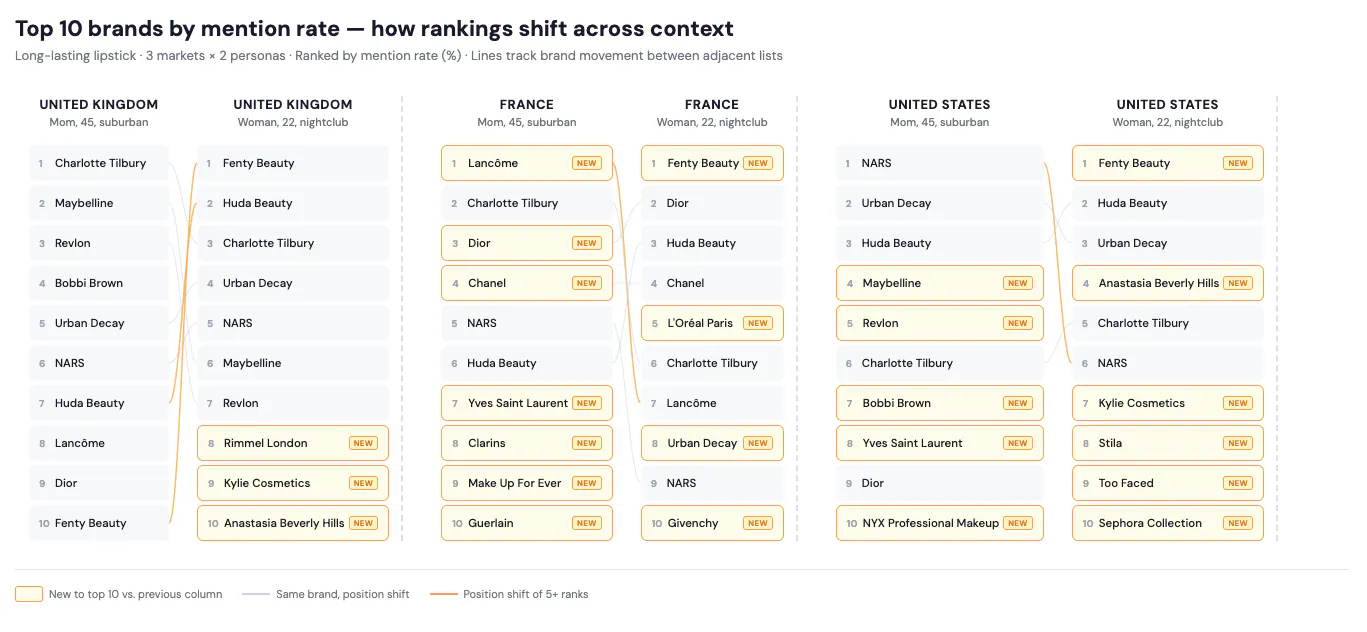
Even in a single product category, changing the context can shift what LLMs think about. Take long-lasting lipstick, for example. If we look across three markets, and two consumer contexts, we get a completely different set of top brands in each.
In one market, as we test additional contexts, we continue to observe LLM sensitivity in brand responses.
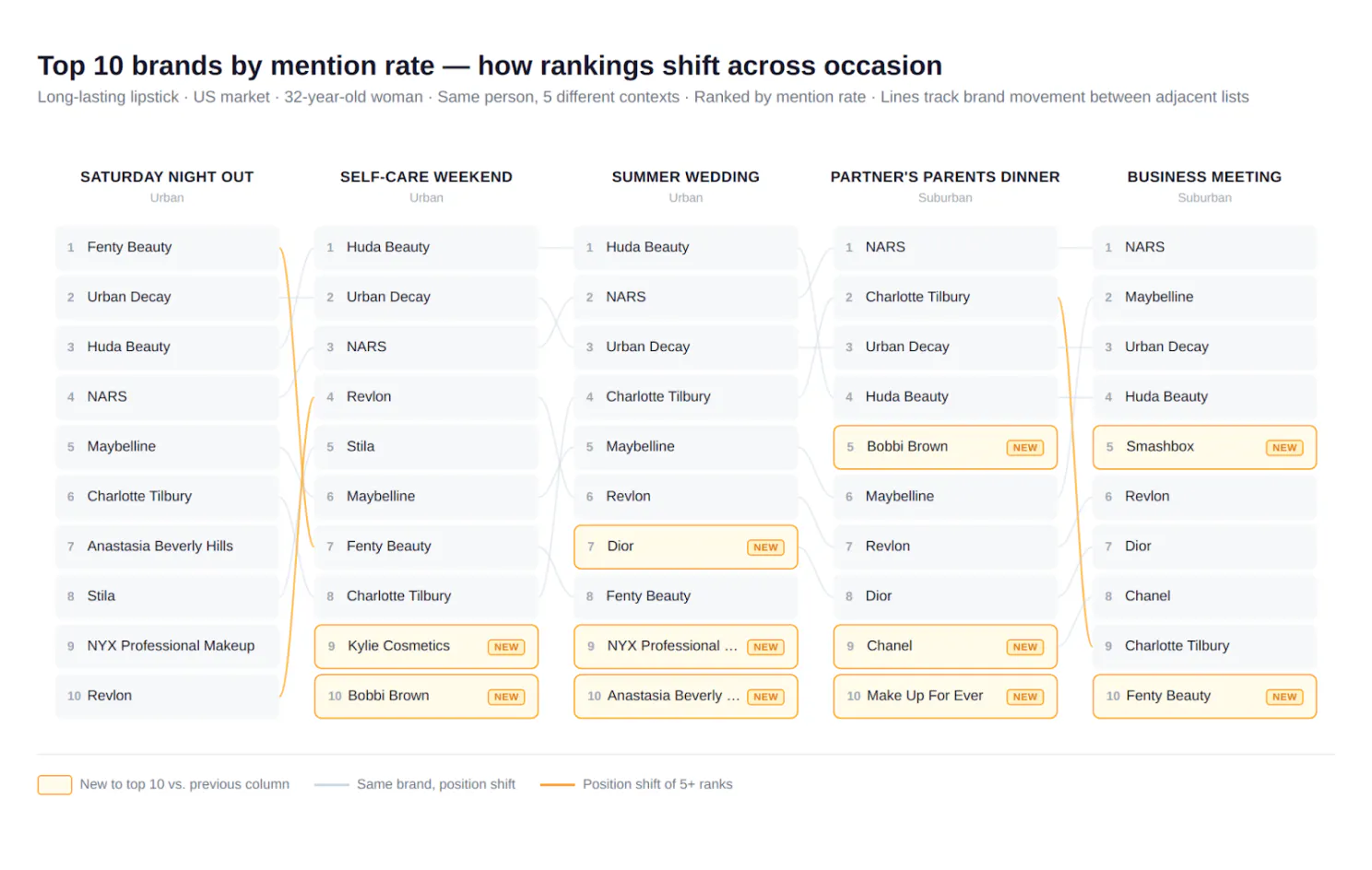
This phenomenon is consistent: context drives the LLM mindset. Just as a Category Entry Point is the situation that triggers brand recall in a person, a Context Entry Point is the situation that shapes which brands an AI model surfaces.
A Category Entry Point lives in human memory. A Context Entry Point lives in a model’s latent space.
Seeing how the models think
To illustrate Context Entry Points, we wanted to find a way to make them visible. To let anyone experience a model's associations the way a person experiences a brand moment: instinctively, not analytically.
So we went beyond text. We used multimodal AI (Gemini & ChatGPT) to generate a photograph of each context, asking the model to picture a scene. These images reveal what the model associates with a given moment and the brands that fit.
We then applied object identification (again using Gemini) to each image, systematically surfacing every brand the model had placed in the scene. The result is a visual record of the LLM's brand associations not as a ranked list, but as a “lived” context.
And you can see the Context Entry Points for yourself now. Our experiment is available on ContextEntryPoints.com
Context Entry Points: building for the future of brand presence
Understanding a brand’s position across Context Entry Points is the start. Collaboration is needed to translate these opportunities into a plan. A traditional comms planning workshop can be adapted for this new era, pulling together cross-functional teams to ideate against the associations and occasions that the brand wishes to target.
Anyone who has experienced an IAT before will know that pulling together perspectives from creative, media, PR, social and eCommerce teams is a task in and of itself. So strong leadership and alignment on the goals is needed from the outset.
We hope that by visualizing the Context Entry Points, we create the incentives to coordinate around the new AI imperatives.
Some key outputs from these sessions should be:
- Context Audit. Teams should identify the contexts that LLMs already link to the brand and where those links are weak or absent.
- Opportunity Gap. Prioritizing Context Entry Points, teams should ideate around building the brand associations across creative, partnerships, earned, social and contextual media opportunities.
- Strategic Context Entry Point Plan: Brands should ultimately build content and distribution plans that strengthen associations with specific situations and moments. This can complement existing campaign or brand planning, where Context Entry Points become part of the strategic foundation for activity that links the brand to the moments that will drive growth.
In the AI era, growth depends not only on being remembered by people but on being retrieved by machines. Brands that master Context Entry Points can increase their chances of being present for the valuable brand occasions in a person’s (and their model’s) life.
The Context Entry Points website is a live gallery. Each day a new context is generated. Find your brand to see where you sit in the context.
Go beyond the prompt. Understand your Context Entry Points.