SEO Copywriting & Content Strategy
Next session: 09 JUN, 2026
R4250EX VAT


Training Director, Chris Hutty, explores what zero-click search really means in 2025, cutting through the noise to help marketers adapt their strategy for an AI-shaped search landscape.
Are you looking at your Google Search Console reports and seeing your clicks dropping while your impressions and even your rankings increase?
Welcome to the zero-click era, where Google answers the search before anyone even thinks about clicking.
This isn’t a passing phase, it’s the reality of modern day search and it’s forcing marketers to think differently about visibility, influence, and the role of SEO.
A zero-click search is when someone gets the answer to their query directly on the search results page, without needing to click through to a website.
That answer might come in the form of a data card, a knowledge panel, in one of Google’s AI Overviews, or within the newly launched AI Mode. These SERP features are designed to satisfy user intent instantly, often before a user even scrolls.
In other words, as far as Google is concerned, the search result is the destination. Let’s be clear though, while challenging, zero-click doesn’t mean zero opportunity. What it means is that the SERP is now doing more of the heavy lifting when it comes to meeting our informational needs, especially for quick factual or informational queries.
Around 60–63% of Google searches now end without a click, according to a July 2024 report from SparkToro and Similarweb. Not because your content isn’t good, but because the game has changed.
A few defining traits of zero-click searches:
This shift has been years in the making. First came knowledge graph panels, then featured snippets and then data cards. Now, with AI Overviews and AI Mode live in the US and UK, we’ve entered a new phase where Google’s search engine behaves more like a conversational assistant than a list of blue links.
When it comes to marketing, it’s not just Google either. Social platforms are doing the same thing, feeding users just enough content to keep them scrolling. No need to click through. No need to leave.
While clicks are down, total traffic from Google isn’t necessarily in freefall. According to SparkToro and Similarweb’s research (above), outbound traffic from Google hasn’t collapsed. Instead, it’s being spread more widely across SERP features, including featured snippets, knowledge panels, and AI modules.
Traditional vs. zero-click search:
Traditional Search Clicks = success SERPs as launchpads Content led the user journey
Zero-Click Search Era Visibility = success SERPs as destinations SERP features interrupt, and often complete, the user journey
Let’s call it what it is. The old model of “rank well and wait for the traffic” is no longer enough.
You might hold a solid position one or two in the rankings, but if your content is outranked by an AI Overview or a direct answer box, your traffic will likely take a hit.
What’s shifting:
Contrary to what you might have read on X or LinkedIn, SEO isn’t dead. However, the rules are changing. Visibility, relevance and cross-platform consistency matter more than ever. Whether SEO as a term is still fit for purpose is the topic of much debate and new descriptors such as AEO and GEO are emerging to describe the broader strategies we need to succeed in this new world.
As of July 2025, Google’s AI Mode is now live in the UK and US. It offers users a conversational interface that replaces the traditional search page, generating answers by synthesising content from multiple sources.
Brands need to be present in the data ecosystems that feed these summaries, which can include multiple sources such as Wikipedia, YouTube, Reddit, social media platforms and reputable media sites. It’s no longer about ranking alone. It’s about being referenced by the engine itself.
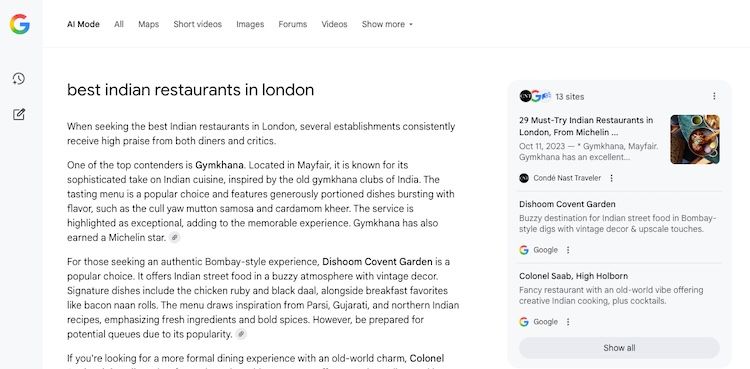
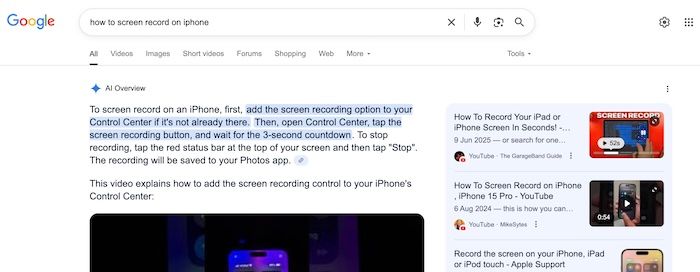
AI Overviews use generative AI to create summaries for more complex queries and have largely replaced Featured Snippets in the search experience. These draw from multiple sources and are designed to provide comprehensive answers at a glance.
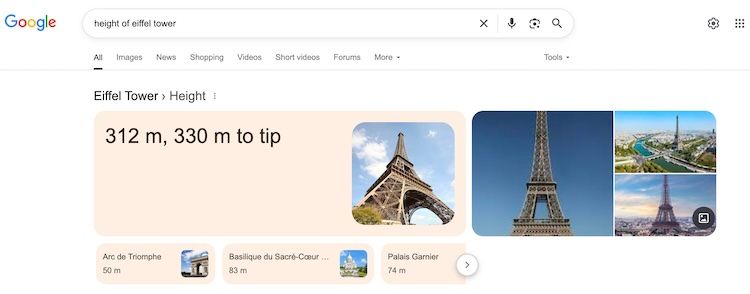
When a query has a factual, objective answer, Google delivers it immediately with no source attribution. Think calculator results or measurements.
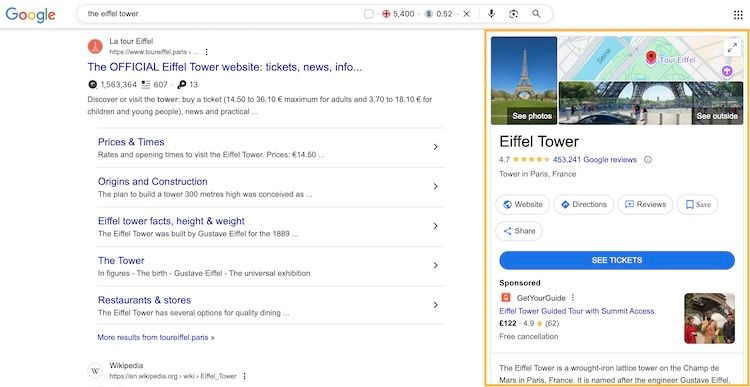
These appear for known entities like businesses, people, or places. They show up on the right side of the SERP with summarised information from trusted sources.
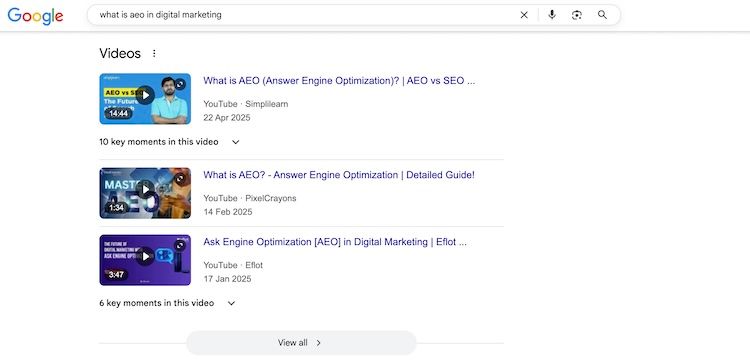
Video is now front and center on many SERPs—especially for how-to queries, reviews, and walkthroughs. These results often appear as carousels, previews, or embedded clips with timestamps, pulled primarily from YouTube.
Technically, users do click on these. But where they land is still within Google’s ecosystem.
So while clicks still happen, they’re more likely to stay inside Google-owned platforms. If you're publishing video content, it's worth thinking about your presence on YouTube as part of your overall search strategy—not just as a separate channel.
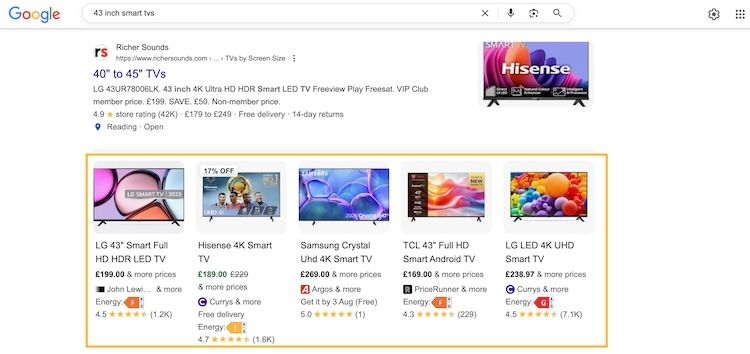
It’s not just information that users can now access without clicking. Products are part of the zero-click mix too.
Google increasingly shows organic product listings directly in the SERP, complete with prices, reviews, images, stock status, and even delivery options. These listings let users compare multiple retailers without ever visiting a website.
If your product appears in these listings, that’s great for brand awareness. But if you're relying solely on click-throughs to convert, you’ll need to rethink the way you present price, trust signals, and value upfront.
It’s not about chasing rankings alone anymore. Instead, you need to optimise for presence, clarity, and machine readability. As AI platforms begin to eat into Google’s search share we also need to think about gaining visibility in these spaces (Answer Engine Optimisation). Google’s recent launch of AI Mode in the US and now India (with other markets to come) only makes this even more important.
So how do we optimise in a world dominated by these Answer Engines?
Identify keywords and search intents that are likely to trigger snippets or direct answers. Use keyword tools to understand which terms already show SERP features.
Think of your content like building blocks. Each paragraph should make sense on its own. Answer queries clearly and concisely. Use headers and lists for clarity.
Schema markup helps Google understand your content and increases your chances of being featured in rich results.
We’re moving beyond search as we know it. AI tools like ChatGPT, Gemini and Perplexity are reshaping how people find answers, especially for exploratory or layered questions. As Google continues to roll out AI Mode in major markets, we’re seeing the shift from search to summarisation play out in real time.
Expect to see:
The search engine is becoming more like a research assistant. That means you need to be present wherever that assistant gets its facts..
This isn’t about giving up on SEO. It’s about thinking like a marketer. You’re not just optimising for search. You’re building influence in the places that search engines and AI tools pull from.
Create content that:
Zero-click search isn’t the end of SEO. It’s a sign that the search landscape is evolving, and so must we.
If your strategy still treats search as a simple ranking contest, you’ll struggle to keep up. But if you shift your focus to visibility, clarity, and influence across the broader web, you’ll start to see where the real opportunities lie.
This isn’t just about traffic anymore. It’s about trust. It’s about becoming the source that Google and AI platforms want to reference, even when users never leave the SERP.
Want to go deeper? Take a look at our new course: From SEO to AEO: Optimising for AI Search. Learn how to adapt your strategy for an AI-first world, build content that gets surfaced across search features, and future proof your brand’s visibility.
Take the next step in your digital learning journey with these featured courses.

Director, Training

Chris Hutty is a digital marketing expert at Jellyfish Training, blending SEO, paid media, and content strategy to help teams grow through data-driven insights and creative execution.
Access the latest digital marketing insights, valuable tips and relevant advice from our experts.
How to blend data sets in Google Looker Studio as a way around default auto aggregation
The content experts at Jellyfish explore the 3 of the best tools - free and paid - to help you find trending topics for content creation
Boost your SEO with Topic & Entity optimization. Learn how this dynamic duo improves search rankings and drives organic traffic
In today's digital world, platforms such as Facebook, Instagram, and TikTok are essential spaces for connecting with your customers. Social media isn't just a "nice to have" it's a must-have
Explore how marketers can bridge the gap between ad reach and audience attention with DV360 Custom Bidding.
Google has now made tracking conversion rates easier for marketers. Learn about the recent introduction of ‘key event rate’ directly into GA4 reports, making it simpler to measure campaign success.
We spoke with our experts across the global SEO team at Jellyfish, who revealed their journeys into the industry and top tips on kick-starting a career in SEO
In this guide, we look at how to list your products for free in Google Shopping results, including how to set and optimise your Google Merchant Centre feed.
Jellyfish Senior Data & Analytics Director Max Yodgee explores options for iframe tracking in gtm
There’s no doubt that things rarely stand still in the world of SEO. Training Director Chris Hutty reveals his favourite resources for keeping up-to-date in this ever-changing industry.
Learn the fundamentals of channel groupings and begin to understand how your traffic is attributed in Google Analytics with our handy guide.
Confused by the latest buzzwords and acronyms in search marketing? Jellyfish Training Director, Chris Hutty, explores AEO and GEO, and how AI is transforming the way brands appear in search.